
A practitioner guide for RCICs on responding to IRCC procedural fairness letters in 2026.
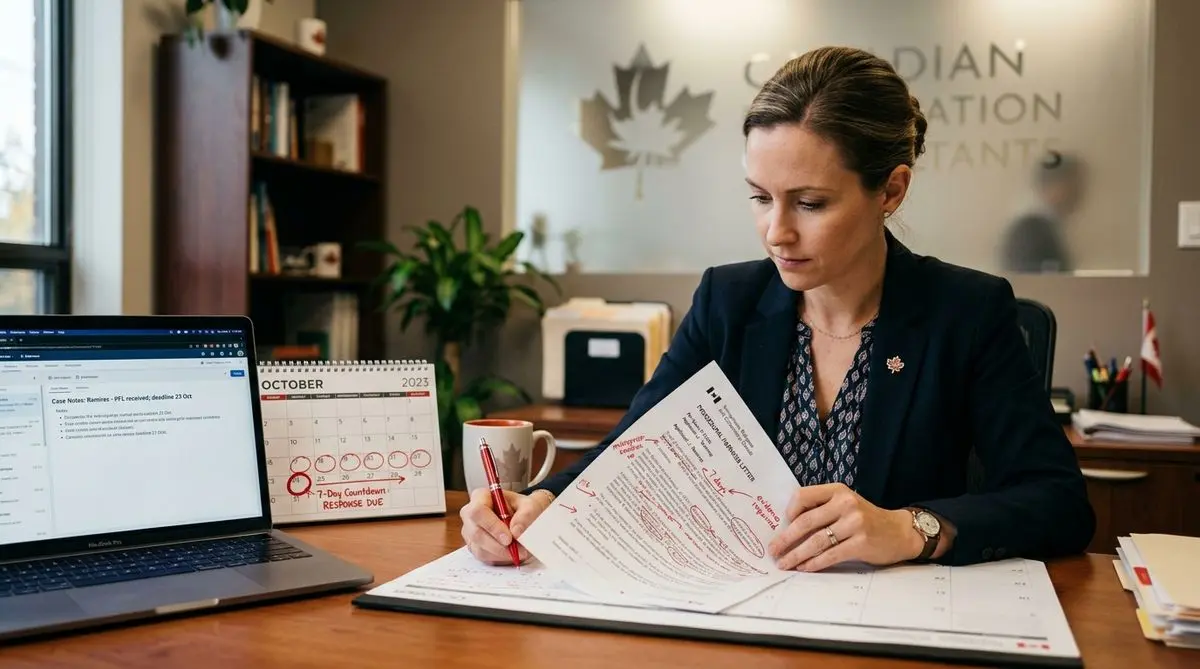
It's Friday at 4:07pm. You're clearing your inbox before the weekend when you see it: IRCC, subject line Procedural Fairness — Request for Submissions. The officer has concerns that your client, whose spousal sponsorship file you've been shepherding for fourteen months, materially misrepresented a prior refusal from another country on their intake forms. You have seven days. Your client is on a plane back from Manila right now with spotty Wi-Fi. The reference letter you need for context is in a GCMS officer's head, not in your file.
Every RCIC has opened that email. The next seven days decide whether fourteen months of work get salvaged or a five-year inadmissibility bar gets stapled to the file. What separates the practitioners who save files from the ones who lose them isn't luck — it's a disciplined response framework. This is that framework.
Why PFLs Are the Highest-Stakes Moment in a File
By the time a PFL hits your inbox, the officer has already formed a tentative adverse view. The letter exists because procedural fairness — a common-law doctrine codified through decades of Federal Court jurisprudence — requires IRCC to give your client a meaningful opportunity to respond before a refusal crystallizes. That meaningful opportunity is also a written record. Everything you submit, and everything you fail to submit, becomes evidence in any future reconsideration request, IAD appeal, or Federal Court judicial review.
The consequences scale with the allegation. A bona fides concern on a visitor visa means a refusal and a potentially harder next application. A section 40 IRPA finding means refusal plus a five-year inadmissibility bar under s.40(2) — a life-altering outcome that closes off Express Entry, spousal sponsorship, and study permit pathways for half a decade. Officers know this. They don't send PFLs casually. Treat every one as terminal absent strong intervention.
Anatomy of a PFL: Four Allegation Families
PFLs divide neatly into four concern categories. Your response strategy differs materially across them, so the first job is classification.
1. Misrepresentation (IRPA s.40)
The most common and most dangerous. The officer alleges a false statement or omission on a material fact — a prior refusal, undisclosed family member, false employment letter, fabricated relationship evidence. Section 40 doesn't require intent; Medel v. Canada, 1990 2 FC 345 and the subsequent innocent-mistake line (notably Sbayti v. Canada, 2019 FC 1296) carve out a narrow defence for applicants who genuinely didn't know and couldn't have known, but the bar is high. Assume the officer starts sceptical.
2. Bona Fides
Primarily spousal sponsorship, common-law partner applications, and — increasingly — work permits under LMIA-exempt streams. The officer doesn't believe the relationship, the job offer, or the study intent is genuine. Evidence-heavy defence territory.
3. Admissibility (IRPA ss.34–42)
Security, criminality, organized criminality, medical, and financial inadmissibility. Each sub-section has its own evidentiary regime and, often, its own remedy (criminal rehabilitation, TRP, medical re-assessment). Don't conflate them.
4. Eligibility
The applicant fails a program-specific criterion: CRS points miscalculated, NOC/TEER category mismatch, insufficient work experience under the PGP sponsor income test, PNP nomination expired. These are often the easiest to fix if the officer is simply wrong — cite the regulation, point to the evidence, correct the record.
What to Extract From the Letter Itself
Before drafting a word, read the PFL three times and extract:
- The specific allegation. Officers are required to particularize concerns (Jahazi v. Canada, 2010 FC 242; Baybazarov v. Canada, 2010 FC 665). A vague "we have concerns about the authenticity of your marriage" without specifics is itself a procedural fairness defect you can flag.
- The deadline. 7 days is common for overseas files; 30 days is more typical for complex in-Canada allegations. Note the exact date and time zone.
- Evidence referenced. If the officer cites an interview, a document, or an anonymous tip, that's your roadmap for what to rebut.
- Officer codes. Useful when you later ATIP the GCMS notes for context.
Deadline Mechanics and Extensions
The deadline in a PFL is not aspirational. IRCC can — and does — refuse the application the day after the deadline passes. But deadlines are also not absolute. Extensions can be requested, and officers grant them more often than junior RCICs assume.
Strong extension justifications include: client travel with verifiable itinerary, document production delays from a foreign government, a new RCIC recently retained and needing time to review the file, translation requirements for non-English/French evidence, or medical/compassionate circumstances affecting the applicant. Weak justifications — the ones that get denied — are RCIC workload, vague "complexity," or "client is busy."
A recent Federal Court decision underscores why extension requests matter. In Sandhu v. Canada (Citizenship and Immigration), 2026 FC 212, Madam Justice Blackhawk found it was a breach of procedural fairness for IRCC to give an applicant 30 days to respond to a concern, then refuse 15 days later before any response was submitted. The refusal was set aside. The lesson for RCICs: document every extension request in writing, confirm receipt, and — if IRCC refuses before your deadline — judicial review is live.
Frame extension requests concisely: one paragraph stating the reason, one paragraph proposing a specific new date, submitted before the original deadline, with a request for written confirmation. Silence from IRCC after a properly filed extension request is not a denial; it's leverage you can cite later if the officer refuses prematurely.
Response Framework by Allegation Type
Responding to s.40 Misrepresentation
Your response has three jobs: (1) correct the factual record where the officer is wrong, (2) concede what's true and explain it without conceding the legal conclusion, and (3) build the innocent-mistake defence where applicable.
Structurally:
- Affidavit from the applicant. Sworn, not just signed. This is the single most important document. Officers weigh a sworn statement much more heavily than counsel's unsworn summary. Address each specific allegation in numbered paragraphs.
- Corroborating documents. Bank records, immigration documents from the foreign jurisdiction, employer letters, whatever disproves or contextualizes the alleged misrepresentation.
- Explanation of the source of confusion. If the applicant used a licensed representative in another country who filled in forms incorrectly, document that. If a prior refusal was genuinely forgotten because it was decades ago, show the gap.
- Legal submissions. Cite Medel and Sbayti for innocent-mistake, cite Baybazarov if the officer hasn't particularized, cite Kazzi v. Canada, 2017 FC 153 on materiality if the alleged omission was immaterial.
A mistake that costs files: resting the entire defence on "my client didn't mean to lie." Section 40 doesn't require intent. The applicant must show they couldn't reasonably have known — a higher bar. Rest the defence there instead.
Responding to Bona Fides (Spousal)
The evidence stack matters more than the legal argument. Officers are assessing credibility from documents.
Build:
- Date-stamped photos across varied contexts (travel, family events, daily life) — avoid consecutive-day bursts
- Joint financial records (accounts, insurance policies, wills, tax filings together)
- Communications history — phone records, messaging app exports, with translation if not English/French
- Statutory declarations from three to five third parties who can speak to the relationship firsthand
- Timeline document reconciling the relationship chronology to any gaps the officer flagged
If the GCMS notes (obtained via ATIP on a prior refusal, or inferred from the PFL language) mention specific concerns — gaps in communication, inconsistent addresses, unfamiliarity with basic biographical details — address those directly in the affidavit. Don't leave the officer's specific concern hanging while you submit generic relationship evidence.
Responding to Admissibility and Eligibility
For admissibility, identify the sub-section and match the remedy: criminal rehabilitation (s.36), TRP for temporary access despite inadmissibility, medical re-assessment with updated specialist reports, financial inadmissibility addressed with updated bank statements and employer letters. Cite IRCC's own operational guidance — it often specifies exactly what evidence satisfies an officer.
For eligibility, the response is usually short and surgical: the officer made a factual or legal error; here is the regulation, here is the evidence already on file, please reconsider. When you're right, brevity wins.
Common RCIC Mistakes That Lose Files
- Over-arguing. A 15-page legal brief when 3 pages of submissions plus a sworn affidavit plus exhibits would be stronger. Officers read volume as weakness.
- Missing the real concern. PFLs often state a surface allegation that masks a deeper issue. Read the GCMS notes if time permits; read between the lines if not.
- Submitting on the deadline with no extension requested. If a key document isn't ready, request the extension in writing. Late submissions without an approved extension are often treated as no response.
- No sworn affidavit from the applicant. Counsel's unsworn narrative carries less weight than an applicant's sworn statement addressing each allegation.
- Blaming prior counsel without documentation. If the real problem is a former representative's error, that defence needs documented proof (retainer agreements, file transfer records, correspondence), not assertion.
When to Escalate: ATIP, Reconsideration, Federal Court
Regardless of how strong your PFL response is, file an ATIP request for the GCMS notes as a parallel track. Even if the PFL response saves the file, the notes are invaluable intelligence for future applications. If the response fails and a refusal issues, the notes become the foundation for your next move.
Reconsideration requests — a letter to the visa office asking them to reopen the decision based on new evidence or a clear error — are available in most contexts within approximately 90 days of refusal. They work best where the officer made a factual error the ATIP-disclosed notes expose clearly.
Federal Court judicial review remains the ultimate check on procedural fairness breaches. Leave must be sought within 15 days of refusal for in-Canada applicants, 60 days for overseas. The grounds most commonly succeeding in 2026: failure to particularize concerns (Baybazarov line), refusal before the PFL deadline expired (Sandhu, 2026 FC 212), reliance on extrinsic evidence not disclosed to the applicant, and unreasonable findings unsupported by the record. Note also the January 2026 Federal Court ruling expanding JR rights to IRCC's "incomplete" application returns — a new avenue previously treated as unreviewable.
Triage which cases justify JR. Leave applications are expensive in client costs and practitioner hours; not every bad PFL response outcome is a winnable JR. But a procedural fairness breach on the officer's part — especially a premature refusal or a failure to particularize — is strong JR territory.
A Practical Seven-Day Workflow
When the PFL lands:
- Hour 1: Read the letter three times. Classify the allegation family. Calendar the deadline.
- Day 1–2: Contact client. File ATIP parallel track. Draft extension request if needed.
- Day 2–4: Evidence collection. Draft applicant affidavit, collect corroborating documents, identify third-party declarants.
- Day 5: Legal submissions drafted. Review affidavit for accuracy with client under oath.
- Day 6: Final review. Exhibits paginated and cross-referenced.
- Day 7: Submit via designated channel (IRCC Secure Account, email to officer, or file-specific submission portal). Confirm receipt in writing.
The RCIC's Edge
PFL response work is the most adversarial-adjacent practice an RCIC does. It blends evidentiary craftsmanship, procedural discipline, and the kind of persuasive legal writing that wins IAD appeals. Treating PFLs as routine administrative paperwork is how files are lost. Treating them as the focused evidentiary exercise they are — with a workflow, a response framework, and an escalation ladder — is how files are saved and how RCIC practices build the reputation that attracts referrals.
The officer isn't the enemy. The officer is a decision-maker responding to what's in front of them. Your job is to make sure what's in front of them is the complete, accurate, persuasive record of your client's case. Every PFL response is an opportunity to do exactly that.
Move Faster on PFLs With VisaFlo
VisaFlo is Modern Canadian Immigration Software built for RCICs and immigration law firms. Four integrated pillars — CRM for client and case tracking, Intake for structured client information gathering, Review for AI-powered document analysis that flags inconsistencies before IRCC does, and Autofill for automated completion of IMM PDFs and IRCC online portals — cut case preparation time by up to 50%. When a PFL lands and the seven-day clock starts, VisaFlo gets you to the response draft faster with fewer manual errors.