
An IRCC application is a finite state machine that advances on its own schedule. This post maps the state taxonomy, compares detection methods (manual portal-checking, email triggers, GCMS notes pulls, programmatic), and shows where status changes should fire client communications and team tasks — with PIPEDA and CICC duty-to-advise considerations.

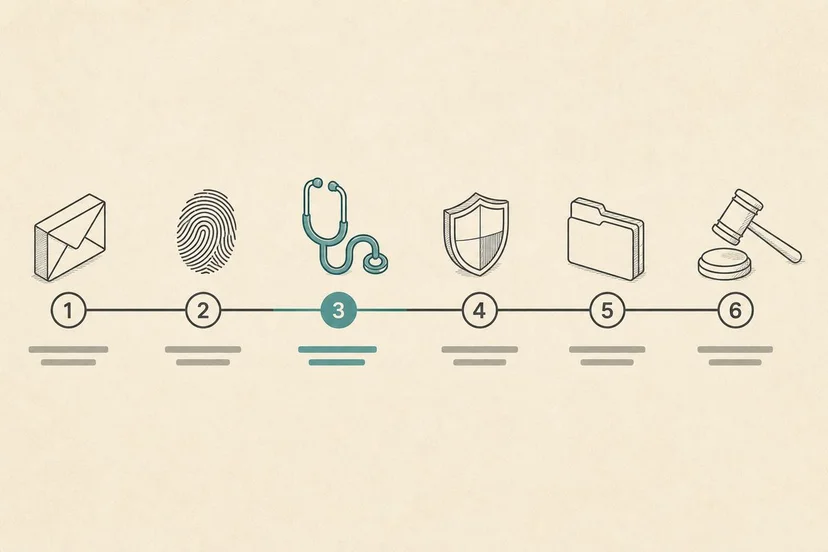
An IRCC application is a finite state machine. It advances through a small set of well-defined transitions — acknowledgement of receipt, biometrics instruction, medical instruction, background and admissibility checks, decision made — and it advances whether or not anyone in the practice is watching. The state changes are silent. The portal does not call. The instruction letter lands in the client's email inbox or the representative account, and from that moment a clock starts running on something the practitioner has not yet seen.
The latency between a transition firing and the file owner discovering it is where files get dropped. A biometrics instruction with a ninety-day window discovered on day sixty-two is a different problem from the same letter discovered on day three. A medical request that sits unread for two weeks because the client copied the practice on a different inbox is a different problem from one routed correctly into the file the same afternoon. The states are public. The transitions are not. Closing that gap is a workflow problem, not a portal problem.
The state taxonomy that a tracking system has to mirror
Any internal status-tracking model has to mirror the categories IRCC actually uses, because every alert, every client message, every task is going to be triggered off one of them. The exact phrasing varies by line of business — temporary residence, permanent residence, citizenship, sponsorship — but the broad lifecycle is consistent enough that a single taxonomy covers most of a practice's volume.
Acknowledgement of receipt
The application has been received and accepted into IRCC's processing queue. For online submissions this is fast and largely silent; for paper submissions it produces a discrete acknowledgement letter (and an application number) that becomes the anchor for everything downstream. The acknowledgement state matters operationally because it is the moment a file moves from "submitted" to "in process," which in most case management systems is where the substantive workflow actually begins.
Biometrics instruction letter
For applications that require biometrics, IRCC issues a biometrics instruction letter (a BIL) with a window for the applicant to attend a collection point. This is the single most time-critical state change for many temporary residence files. The window is not negotiable. The BIL itself is dispatched to the applicant — sometimes with the representative copied through the portal, sometimes not, depending on how the file was filed — and detection has to happen somewhere other than the applicant's personal inbox if the practice is going to be reliable.
Medical instruction
For application streams that require an immigration medical examination, the medical instruction letter signals that the applicant should see a panel physician. Medicals have a defined validity window, which means that a medical completed too early can expire before a decision is made and a medical completed too late can hold the file in security or admissibility. The instruction is a state transition; the medical's own validity is a derived deadline that the practice has to track on top of it.
Additional documents request
When IRCC needs more information — updated police certificates, proof of funds, relationship evidence, a clarifying statement — the request lands in the file with a response deadline. This is the state change most often missed, because additional document requests can arrive months after submission, in periods when the practice has stopped actively touching the file. A request discovered on the deadline is a different kind of risk than one discovered the morning it lands.
Background, security, and admissibility
Once required documents are in, the file moves into background and admissibility processing. From the practitioner's outside view this state can look static for long stretches — the portal may show no movement for weeks — but internally the file is being routed through criminality, security, and (where applicable) medical admissibility checks. The practical implication for tracking is that "no change" during this period is itself the expected state, and the alerting logic has to know not to fire false-positives every time the portal is polled and the displayed status string is identical.
Decision made
The terminal transition. The file is approved, refused, or returned. For approved files, the next downstream state — passport request, COPR issuance, enabling document, etc. — depends on the line of business. For refusals, the decision letter triggers a separate set of internal workflows (PFL analysis if there was one in the lead-up, reconsideration, judicial review timing, client meeting). The decision state is the one place where missing the change is expensive in both directions: a client kept in the dark about an approval is a service failure; a client who learns of a refusal from their own portal before their representative does is a relationship failure.
Detection: how practices actually find out the state changed
There are four detection methods in common use, and most practices use a combination, often without naming them as a system.
1. Manual portal-checking
Someone — the file owner, an assistant, a paralegal — logs into the representative portal on a cadence and reads the status of every active file. This is the baseline that almost every practice still maintains as a backstop, and it is also the method that scales worst. The cadence is constrained by human attention, which means that on a busy week the polling interval lengthens. The portal's per-client account model adds friction: each login is a session, each session is bound to a single account, and switching is not free. A roster of fifty active files is fifty logins on whatever cadence the practice can hold to.
Manual polling also has a quiet failure mode: the brain optimizes. After enough sessions where nothing has changed, the reviewer starts skimming, and a subtle change — a status string that has shifted from "in progress" to "in progress, additional documents requested," for example — can be missed even when it is on the screen.
2. Email-triggered detection
Most state transitions produce a corresponding email — to the applicant, sometimes to the representative, depending on filing path. Treating the inbox as the source of truth is workable, with two caveats. First, the practice has to be on the email address that actually receives IRCC correspondence; a personal address the client used at submission is invisible to the practice unless it is rerouted, forwarded, or copied. Second, the inbox is a noisy channel. IRCC correspondence sits next to client questions, vendor invoices, calendar invites, and newsletters. A medical instruction letter routed to the same shared inbox as a billing question can be lost in volume without filters, labels, or a routing layer that pulls IRCC traffic into a structured queue.
Done well, email-trigger detection is the fastest method by far — the email lands within minutes of the state change, and the trigger logic can fire on the email itself rather than on a polling interval. Done badly, it is the easiest method to fail silently.
3. GCMS notes pulls
An ATIP request for the GCMS notes is the most complete view of a file, and it is the only method that reliably surfaces officer-side annotations that never appear in the portal. Notes pulls are not a real-time detection method — turnaround runs in weeks — but they are the right tool for understanding state changes that have already happened and for diagnosing why a file has stalled. Treating GCMS as a periodic forensic check on long-pending files, layered on top of real-time detection, is the standard pattern. Treating GCMS as primary detection is not viable for live workflow.
4. Programmatic detection
Programmatic detection — scripted polling of the portal, structured parsing of incoming IRCC emails, integration into a case management layer — is what most practices migrate toward as their volume grows past the point where manual cadence can hold. The technical detail varies. Some practices script the portal directly with browser automation; some route IRCC emails through a parser that extracts the application number, the new status, and any mentioned deadline; some buy a layer that does both behind a single dashboard. The architectural property is the same: the detection runs on the system's schedule, not the practitioner's, and the human attention budget is reserved for the action that follows the detection rather than the detection itself.
The trade-off is fragility. Portals change; HTML structures change; email formats change; an automation that worked in February can break in April with no announcement. Practices that rely on programmatic detection need either a maintenance commitment or a vendor that absorbs that maintenance.
Workflow integration: what a state change should fire
Detection without action is just an alert that fades into the rest of the day's noise. The reason to invest in tracking is that each state transition should fire a defined, reproducible response — partly to the client, partly to the team, partly to the file itself.

Client-facing actions
Every transition has a corresponding message that the client should receive, in language the client can act on. The acknowledgement-of-receipt message confirms that the file is in the queue and sets expectations for the next stage. The biometrics instruction message tells the client where to attend, what to bring, and what the window is. The additional documents request message is the most consequential — it has to land fast, contain the actual list, and either schedule the document collection or confirm a deadline. The decision message has to land before the client sees it themselves, which is the entire reason real-time detection matters.
Designing these messages once, as templates that can be triggered on transition, is one of the highest-leverage moves in case management. The first time a client gets a same-day biometrics walk-through, the relationship shifts; the third time, it becomes the expectation.
Team-facing actions
Internally, each transition should produce a task on the right person's queue with the right deadline. A biometrics instruction creates a task for the file owner to confirm the appointment was booked and a follow-up task seven days before the window closes. A medical instruction creates a task to send the panel-physician list and a follow-up to confirm the medical was attended. An additional documents request creates a task to assemble and review the response. A decision creates a task to debrief, file, and either close the matter or open the next stage.
Tasks tied to state transitions are different from tasks tied to dates: a date-triggered task fires whether or not the underlying file did anything, while a state-triggered task fires only when the file actually moves. Both have a role; mixing them deliberately is the discipline.
File-facing actions
The file itself needs the transition logged in a structured way: the new status, the timestamp, the source of detection, any associated deadline, and a copy of the underlying letter or email if one exists. This is the audit trail the practice will need if a question is ever raised about when something was known and what was done with that knowledge. It is also the substrate that makes any later analytics meaningful — turnaround times by stream, common stall points, refusal-rate patterns. None of that analysis is possible if state transitions are recorded as freeform notes in a file diary.
Compliance considerations
Tracking systems handle personal information about applicants and (in many cases) family members. Two compliance frameworks bear directly on how that data is collected, stored, and used.
PIPEDA
Under PIPEDA, the practice is the custodian of the client's personal information and is responsible for safeguards proportional to its sensitivity. Immigration data is highly sensitive — it includes identity documents, biographical history, family relationships, criminal history (where disclosed), medical information, and financial information. A tracking system that ingests IRCC correspondence is, in effect, a secondary store of that information; it inherits the same custody obligations as the case file itself.
The practical implications: data should reside in jurisdictions consistent with the practice's privacy disclosures (which for most Canadian practices means Canadian or equivalent-protection jurisdictions), access should be restricted to the staff who need it, transmission should be encrypted, and retention should be aligned with the practice's broader retention policy. A vendor handling IRCC traffic on the practice's behalf is a data processor relationship that should be documented in writing.
CICC duty to advise and the duty of candour
Under the CICC Code of Professional Ethics, the consultant has obligations to keep the client informed about material developments in their file. A state transition is, in most cases, a material development. A failure to advise the client of a state change in a timely fashion — particularly one with a deadline attached — is not merely a service issue; it is potentially a regulatory issue.
The case for automation here is straightforward. Manual systems fail in proportion to volume; the duty does not scale down because the practice is busy. A tracking system that reliably surfaces transitions and reliably fires the client message is, among other things, an instrument of regulatory compliance. Practices that document their tracking architecture as part of their broader file-management system are in a stronger position if ever asked to demonstrate the basis for their advisory practices.
A note on what not to over-engineer
Most practices do not need a custom-built tracking platform. Most practices need a deliberate combination of the four detection methods, mapped against the state taxonomy, with templated client and team responses tied to each transition. The architecture is straightforward; the discipline is in implementing it consistently across every active file rather than only on the cases that happen to be top of mind.
The litmus test is whether the practice can answer one question on demand: for any given active file, what state is it in, when did it enter that state, what is the next expected transition, and what action is currently on someone's queue against it. If the answer requires a portal login, the system is not yet operating as a system. If the answer is a row in a dashboard, it is.
Closing
VisaFlo is built around the model in this post. The status-tracking layer sits inside a broader Canadian-immigration case management system — alongside intake, document review, retainers, e-sign, and IRCC autofill — so that state transitions fire client messages, team tasks, and structured file logs without anyone polling a portal manually. If the architecture above maps to the way your practice already wants to operate, book a demo and we will walk you through how it runs on a live caseload.