
IMM file preparation isn't authoring; it's translating intake data into IRCC's published question schema. Map the schema, and the time-cost categories show themselves.

Every IMM application form is, structurally, a translation. IRCC publishes a fixed question schema across IMM 0008, IMM 5645, IMM 5669, IMM 5406, IMM 5257, IMM 1294, and IMM 1295. The intake call gives you the raw material — names, dates, addresses, employers, schools, family. The work between those two points is converting one into the other. It is mechanical, line by line, field by field, and it scales badly when done by hand.
That framing matters because most preparation-time conversations in this profession are framed around the wrong unit. RCICs talk about "drafting an application" as if it were authoring. It isn't. Authoring happens in the submission letter, the H&C narrative, the procedural-fairness response. The IMM forms themselves are not authored; they are mapped. And once you accept that, the question of how to reduce IMM preparation time stops being a question of speed and becomes a question of schema.
The form family as a schema
Treat the IMM family as a single distributed form rather than seven separate ones, because that is how it behaves in practice. The same client data points appear across multiple forms — a residential address that needs to be on IMM 0008 also belongs on the IMM 5669 ten-year history, a parent's date of birth on IMM 5645 also belongs on IMM 5406. The client provides each fact once. IRCC asks for it many times, in slightly different formats, with slightly different wrappers.
The forms group themselves into rough functional roles. IMM 0008 carries the spine of the application — the applicant, the program, the dependants, the declaration. IMM 5645 and IMM 5406 fill in the family graph IRCC needs to verify the relationships claimed on IMM 0008. IMM 5669 reaches backward in time to capture the residential, work, and travel history that supports admissibility analysis. IMM 5257, IMM 1294, and IMM 1295 attach when the program demands them — visitor visa, study permit, work permit. The wrappers differ; the underlying schema overlaps heavily.
Once you read the family this way, the time-cost question becomes tractable. Some categories of fields cost almost nothing. Others cost an order of magnitude more. Mapping the schema onto its time-cost categories tells you where preparation hours are actually going.
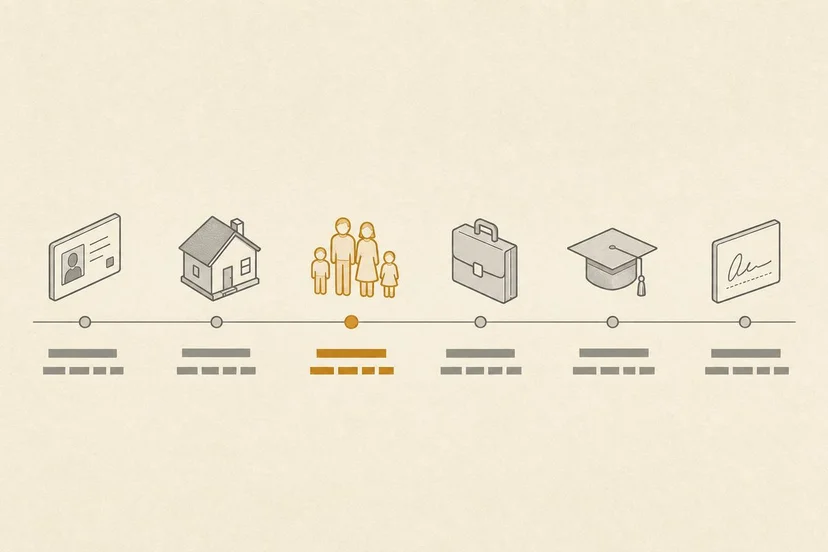
Six categories of fields, six cost profiles
If you look at every field across the family of forms and group them by what kind of work they require, six categories emerge. Each has a different time profile, a different error profile, and a different relationship to whatever software you have running underneath the file.
Identity
Names, date of birth, place of birth, gender, citizenship, passport details, UCI when one exists. These are the cheapest fields in the entire schema. The client provides each value once at intake; it transfers verbatim into every form that asks for it. IMM 0008, IMM 5645, IMM 5669, IMM 5406, IMM 5257, and the program-specific forms all want the same identifying data, formatted in compatible ways. There is no interpretation. The work is pure copy across surfaces.
Identity fields are also the most embarrassing place to make mistakes. A passport number that is correct on IMM 0008 and wrong on IMM 5257 because someone re-typed it makes the entire file look unserious, even when the underlying analysis is sound. Time saved here is small per field; time saved across an entire family of forms is significant; and the cost of an error is disproportionate.
Residential history
The IMM 5669 reaches back ten years for residential addresses, with no gaps. Dates of arrival and departure for each address are required, and the format is unforgiving — month and year, sequential, no overlaps, no missing months. IMM 0008 also asks for the current address. Other forms in the family pull a subset.
The cost profile is the opposite of identity. Each residential entry is several fields wide. Clients rarely arrive with this information ready; they reconstruct it from memory, from emails, from rental records. The intake call typically captures a partial list, and a follow-up email captures the rest. Once collected, the data transfers cleanly across forms — but the collection itself is the long pole.
Family composition
IMM 5645 and IMM 5406 are the two forms most explicitly devoted to mapping the applicant's family. Spouse, children, parents, siblings — each with names, dates of birth, occupations, addresses, marital status. IMM 0008 requires its own subset under the dependants section.
Family composition fields look identity-like at first, but they aren't. They require interpretation that intake forms often don't capture. Is a stepchild listed? Is a deceased parent listed (yes — with date of death). Is a divorced spouse from a previous marriage relevant on IMM 5645? Different program contexts shift these answers. Family fields look mechanical and behave editorially.
Travel history
IMM 5669 also asks for every trip outside the country of nationality and country of residence, going back ten years. Country, purpose, dates. Most clients do not remember every trip. Many under-report. Some over-report when they confuse business travel with personal travel.
Travel-history fields have the highest verification cost in the entire schema. The client's recollection has to be reconciled with passport stamps, eTA records, prior visa records, sometimes employer travel logs. The fields themselves are simple. The work behind each one is not.
Employment and education
IMM 5669 asks for personal history — employment, education, military service, gaps — going back ten years, with no unexplained periods. IMM 0008 asks for current employment and intended occupation. IMM 1295 work permit applications add intended employer, NOC code, and offer-of-employment details. IMM 1294 study permit applications add the designated learning institution and program.
This is the second most time-expensive category, behind travel. Each entry is multi-field. Date precision matters. Employment gaps must be explained, not skipped. NOC code selection requires judgement. The data is often well-known to the client but rarely well-organized at intake. Most of the back-and-forth in the late stages of file preparation lives here.
Declarations and consent
Every form ends with declarations — accuracy attestations, representative declarations, consent to disclosure. IMM 5476 covers the use of a representative. IMM 5475 covers consent for personal information disclosure. IMM 5669 ends with a personal declaration that has its own legal weight under section A40 of the IRPA.
Declaration fields look administrative and are the highest-stakes fields in the schema. Their time cost in preparation is small. Their error cost is enormous; an unsigned declaration delays the file by weeks, and an inaccurate declaration creates an A40 risk that no amount of file-prep efficiency can offset.
Translation work: what transfers, what doesn't
Once the schema is grouped by category, the translation work becomes legible. Some categories transfer 1:1 from a structured intake. Others require interpretation that no intake form, however thorough, can fully capture in advance.
Identity transfers 1:1. If the intake captures the correct passport number, date of birth, and place of birth in a structured field, that data populates every form that asks for it. There is no decision to make at the form-prep stage. The only failure mode is mis-entry at intake; once entered correctly, the rest is duplication.
Residential history transfers 1:1 once collected, but collection is rarely complete from a single intake. The translation step here is gap-closing — the client provides eight addresses, the IMM 5669 demands ten years, and the missing months get filled in iteratively. No software shortcuts the gap-closing conversation; software can, however, ensure that once the gap is closed, the data flows into every form without re-entry.
Family composition transfers conditionally. Whether a stepchild appears on IMM 5645 depends on whether the client lists the stepchild as a dependant, which depends on whether the program permits dependant inclusion at this stage, which depends on the file strategy. The translation step is editorial. A purely mechanical autofill that copies every named relative onto every form will produce a wrong file roughly as often as it produces a right one.
Travel history is the category where translation is most strained. The intake captures the client's recollection. The forms demand a reconciled record. The reconciliation is its own work product; it sits between intake and form, and it is the step that benefits least from naive automation. A passport-stamp scan plus a structured interview is the realistic input; any system that promises to skip this step is selling you a future amendment letter.
Employment and education transfer 1:1 within a single application but rarely within a single intake. Clients frequently mis-date job tenure by several months in casual conversation. Re-checking employment dates against pay stubs, T4s, or employer letters is part of preparation, and the structured fields can only be populated correctly once that re-checking has happened.
Declarations don't transfer at all. They are signed at the moment they are signed, after the rest of the file is final. Treating the declaration page as a transferable field — pre-populating the date, pre-checking a box — invites errors that cost more than they save.
Verification: the cross-check layer
Even when every category is filled correctly, the file is not done. There is a verification layer that sits on top of the schema and checks for internal consistency across forms. This layer is invisible to most workflow descriptions but accounts for a non-trivial share of preparation hours on any file that reaches IRCC without a procedural-fairness letter.
The cross-checks worth running on every file include: residential history on IMM 5669 against current address on IMM 0008 against any address listed in the supporting employment letter; family composition on IMM 5645 against dependants on IMM 0008 against the family information appended to IMM 5406; travel history on IMM 5669 against passport stamps and prior visa records; declared employment on IMM 5669 against any employment letter, T4, or NOA in the supporting documents; date-of-birth values across every form (a single typo here is an automatic refusal risk); UCI values across every form when a UCI exists; signature pages dated within a reasonable window of the submission date.
These checks are cheap when run; expensive when missed. A spousal sponsorship file refused because IMM 5645 listed a parent as deceased and the supporting letter referenced the same parent in the present tense is a real refusal pattern. A study permit refusal because the IMM 1294 program dates didn't match the letter of acceptance is a real refusal pattern. The cross-check layer is where translation errors become file errors.
Most RCICs run these checks manually, with a printed copy of the file and a highlighter. That works, and it is slow, and it does not scale to a busy practice. The category of work is mechanical — identity field A on form 1 must equal identity field A on form 2 — and mechanical work that can be specified can also be automated.
Where autofill helps, and where it can hurt

Once the schema and the time-cost categories are mapped, the question of where autofill is useful becomes specific rather than philosophical. The categories where autofill straightforwardly helps are the ones where translation is 1:1: identity, residential history (post-collection), employment and education (post-verification), family composition where the dependant decision has already been made. Across these categories, autofill is doing what manual entry was doing — only faster, and with fewer transcription errors.
The categories where autofill earns its weight are the cross-check layer. Comparing identity values across every form in a file is exactly the kind of mechanical, rule-bound work that machines do better than humans with highlighters. So is checking that residential history has no gaps, that family composition is consistent, that signature dates fall within an acceptable window. These are not subjective judgements. They are constraint checks, and offloading them is the highest-leverage use of automation in this entire schema.
The categories where autofill can actively hurt are the editorial ones: family composition before the dependant decision is made, travel history before reconciliation with passport stamps, employment and education before date verification, and the declaration page at any time. In each of these, the field looks mechanical but the answer is editorial. Pre-filling a field whose correct value depends on a decision the practitioner has not yet made converts a clean blank into a quietly wrong default. Quietly wrong defaults are the worst kind of error in a regulated workflow because nothing on the page signals that they need review.
The practical implication is that autofill is not a binary feature. A system that pre-populates everything as soon as intake closes will produce files that look complete and contain editorial errors. A system that pre-populates only the categories where translation is 1:1, holds the editorial categories open, and runs the cross-check layer over the whole file before submission will save genuine hours and not introduce new failure modes.
A working sequence for a file
If the goal is reducing preparation time without sacrificing accuracy, the working sequence on a typical file falls out of the schema analysis. Capture identity at intake in structured fields, not free text. Capture the easy parts of family composition at intake; flag the editorial questions for the practitioner to resolve before any form is touched. Run residential and travel history collection as iterative loops, not one-shot fields, and treat reconciliation against documents as its own task on the file plan. Verify employment dates against documents before populating any form. Map identity, residential history, family composition (post-decision), and verified employment 1:1 across the entire family of forms in a single mapping pass. Run the cross-check layer over the whole file before any signatures are gathered. Gather signatures last, with the declaration page reviewed in the same sitting it is signed.
The sequence isn't novel; most practitioners already follow some version of it. What the schema view changes is which steps deserve software help and which steps don't. Mapping and cross-checking deserve software. Editorial decisions and reconciliation conversations don't, and a system that pretends they do is a system that ships wrong files faster.
What the time savings actually look like
When practitioners talk about reducing IMM preparation time, the figure that gets quoted most often — somewhere around half — is real, and it comes almost entirely from two places: 1:1 mapping across the family of forms (the identity, residential, employment, and family composition pass) and the cross-check layer (consistency across forms before submission). It does not come from automating the editorial categories, which are roughly the same amount of work whether software is involved or not.
That distinction matters when evaluating any tool that claims to reduce IMM preparation time. The honest version of the claim is: the mechanical categories shrink dramatically; the editorial categories shrink by single-digit percentages, mostly through reduced friction. Anyone selling a larger reduction across all categories is either understating the editorial work, overstating the mechanical work, or quietly producing files that still need a manual second pass before submission. The schema is the ground truth; any time-savings claim that doesn't decompose along these categories should be treated with the same skepticism as a refusal that doesn't decompose along its grounds.
Closing — the schema is the lever
The single most useful exercise an RCIC can do for their own practice is to print one copy of every form in the family and read them as a single distributed schema. Group the fields by category. Mark which categories are mechanical, which are editorial, and which sit on the cross-check layer. Note where the same data point appears more than once. The picture that emerges is the picture of where preparation time actually lives in the practice — and once it's visible, decisions about software, about intake design, about file plan structure, about staffing, all sharpen up.
VisaFlo is built around this schema view. The intake feeds structured fields, the autofill maps the mechanical categories across the IMM family in a single pass, and the cross-check layer runs over the file before submission. The editorial categories are kept editorial — held open for the practitioner, not pre-filled into a quietly wrong default. If the analysis above matches the way file preparation feels in your practice, it's worth seeing the workflow side by side. Book a demo and we'll walk through it on a file of your choosing.