
A practitioner framework for tracking the deadline cascade across IRCC procedure, CICC compliance, Federal Court timelines, and provincial program windows.
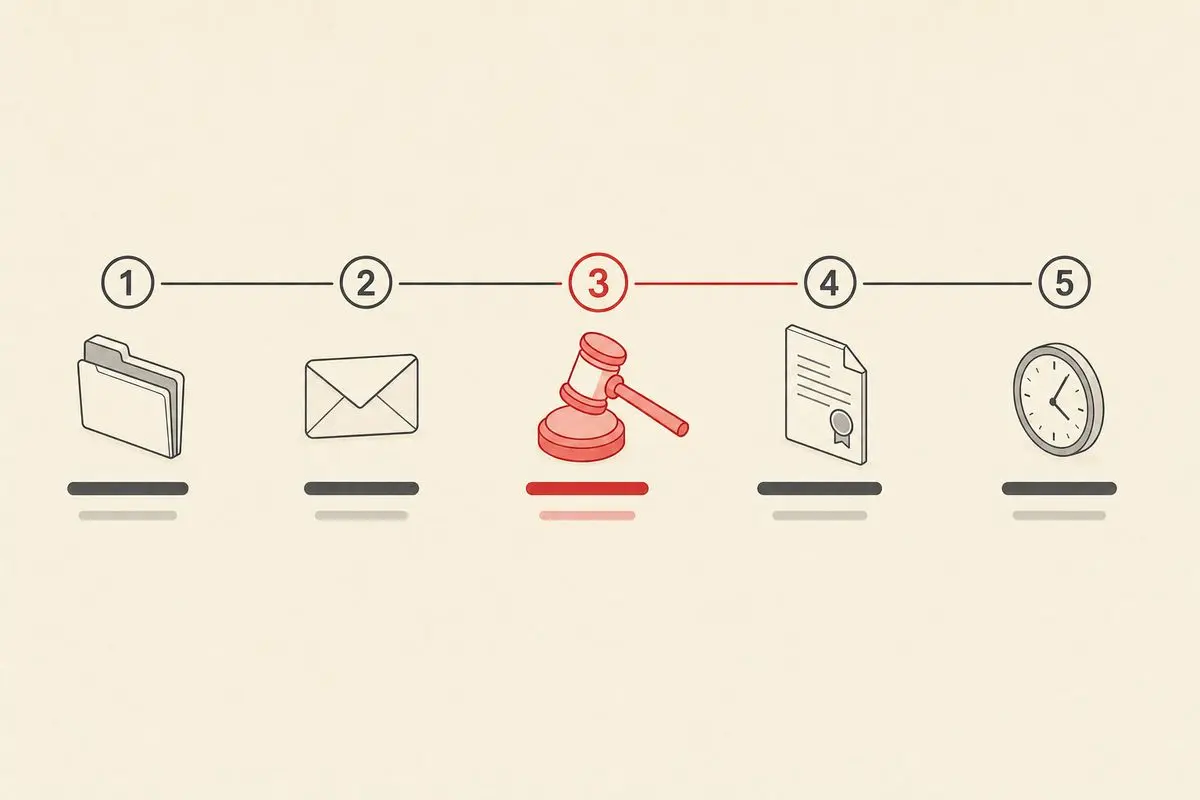
Take a single inland spousal sponsorship file with a thin background admissibility issue and run the deadline ecosystem. There is the Procedural Fairness Letter response window, drafted into the file the day the GCMS letter lands. There is the R10 missing-documents window from the original receipt review, still active for any item flagged at intake. There is the biometrics validity window, ticking from the day they were captured. There is the upfront medical certificate, valid for a fixed window from the date of the IME. There is the Federal Court leave-and-judicial-review window if the file refuses, fifteen days inland and sixty days outland under the Federal Courts Citizenship, Immigration and Refugee Protection Rules. There is the CICC continuing professional development cycle, the trust account reconciliation cycle, the file retention clock that keeps running long after the client has stopped paying. There is the retainer review date that nobody calendared because it was just a Word document. There is the refusal-to-reapply timing question, which is not a deadline so much as a strategic window inside which the next application should land. One file. Eight surfaces. Different systems. No single calendar.
This is the part of practice that nobody trained for. Procedure law school teaches the windows individually. The CICC entry-to-practice exam tests them in isolation. What no curriculum covers is the operational problem: when an active caseload runs forty, eighty, two hundred files at varying stages, the windows from those files compound across systems that do not talk to each other. A practitioner who has never missed a deadline on any single file can still be one bad week from missing one across a caseload. The discipline summaries published by the College of Immigration and Citizenship Consultants make this point repeatedly. So do the costs orders in Federal Court refusals where a missed step turns into a constructive abandonment.
What follows is a working framework for tracking the deadline cascade across IRCC procedure, CICC regulatory compliance, Federal Court timelines, and provincial program windows — without inventing windows that do not exist and without treating the caseload as if it were one file at a time.

The taxonomy: four families of deadline, four logics
Before any tracking system, the deadlines themselves need to be sorted by family. They behave differently. They live in different documents. They fail in different ways.
IRCC procedural deadlines
These are the windows imposed by IRCC on the applicant or their representative during the life of an application. The Procedural Fairness Letter response window is the canonical one — typically stated on the face of the letter itself, with a specific date, and with the consequence of refusal if missed. R10 of the Immigration and Refugee Protection Regulations sits underneath the missing-documents flag at receipt review: applications that fail R10 completeness are not entered into processing, which makes the response to a returned application its own time-pressured surface. Biometrics validity sits inside its own retention window from the date of capture. Upfront medical certificates are valid for a fixed window from the date of the immigration medical exam, and a file that sits in queue past that point will receive a request for a new IME — sometimes mid-processing, when the original was performed at intake.
The common feature of this family: the window is set by IRCC, communicated through GCMS-generated correspondence or the receipt letter, and the date is generally specific. The failure mode is administrative — the letter goes to a portal account that nobody is monitoring, or the letter goes to a paper address that the client has moved away from, or the date is read off the letter and entered manually into a calendar with a transcription error.
CICC regulatory deadlines
These are the windows imposed by the regulator on the practitioner, not on the file. Continuing professional development cycles run on a schedule set by the College, with annual reporting and category requirements. Trust account reconciliations run on a separate cycle with their own retention requirements. File retention itself is its own clock. Annual licence renewal sits in this family. So does the conflict-check obligation that engages each time a new lead is intaked.
The common feature here: the deadline is not file-specific, but missing one of these can sweep through the entire caseload simultaneously. A lapsed licence renders every active retainer non-compliant on the day it lapses. A missed CPD reporting window triggers a College process that the practitioner has to manage on top of the active files. A trust reconciliation that drifts past its scheduled cycle exposes the practitioner to a different kind of regulatory finding entirely.
Federal Court deadlines
These are the only deadlines in the system with statute-grade rigidity. The leave-and-judicial-review window under the Federal Courts Citizenship, Immigration and Refugee Protection Rules is fifteen days from the date the applicant was notified of the matter, for inland decisions; sixty days for outland. Extensions are technically available but require leave and a satisfactory explanation, and the case law is unforgiving for missed windows that lack a real explanation. Once leave is granted, the perfection of the application record runs to a separate schedule. Memoranda of argument run to their own deadlines. Cross-examinations on affidavits, when used, sit on top of all of the above.
The common feature: a missed Federal Court deadline often cannot be cured. The fifteen-day window in particular is the single hardest deadline in Canadian immigration practice for a representative carrying a working caseload, because it begins running before the client has decided whether they want to pursue judicial review, before the file has been reviewed for prospects, and before any retainer for the JR work has been signed.
Provincial and program-specific deadlines
Provincial nominee programs operate on their own clocks. Notification-to-respond windows after a draw vary by stream and by province. Post-nomination, the Express Entry side of a PNP file imposes its own response window once the applicant receives an invitation to apply. Atlantic Immigration Program endorsement timelines run on the provincial side; the federal application that follows runs on the IRCC side. LMIA streams have their own validity windows for the assessment, separate from the work permit application that follows. Quebec processes operate on a parallel calendar entirely.
The common feature: each program has its own logic, often described in its own operational manual, and the windows do not always line up with the IRCC-side windows on the same file. A file that is on the federal clock for one purpose can simultaneously be on a provincial clock for another.
Where deadlines actually slip
The discipline reports and the Federal Court refusals show a recognizable shape to the failures. Almost none of them involve a practitioner who simply forgot. The patterns are operational.
The first pattern is a deadline that was visible on the day the letter arrived and then drifted because the file moved out of active attention. The PFL came in. The practitioner read it, made a mental note, intended to draft the response that week, and then a different file went into a Procedural Fairness response, then a refusal, then a leave application, and the original PFL sat in the inbox until the response window had already started to compress against the calendar. The deadline was never unknown. The triage was the failure.
The second pattern is a deadline that lived in a system that nobody was treating as a deadline source. Biometrics validity is a frequent example. The IME validity window is another. These dates are not announced by an IRCC letter the way a PFL date is. They sit inside the receipt and inside the medical certificate and inside whatever internal note the practitioner made at intake. If those documents are filed in a way that does not surface dates, the dates do not exist for the practitioner until something prompts them — usually a request for an updated IME deep into processing, by which point the file has lost time.
The third pattern is a deadline that started running before the practitioner had been retained for the next stage. The fifteen-day Federal Court window for inland matters is the canonical instance. The refusal lands. The client takes a few days to process it. They book a consultation. They decide they want to proceed. They sign the JR retainer. The clock has been running the entire time. A representative who is not building the leave application before the retainer is signed — at minimum, doing the prospects review and starting the materials — is functionally working with a window of less than fifteen days.
The fourth pattern is a regulatory deadline that drifted because file work crowded it out. A CPD year that ends with hours under the threshold because there was always a file pending. A trust reconciliation that ran late because the bookkeeper was waiting on a statement and the practitioner stopped chasing. A file retention review that never happened because nobody owned it. These are not heroic failures. They are time-allocation failures.
The fifth pattern is the one that is hardest to see in advance: the cascade. One missed deadline does not kill a file. Two compounding deadlines often do. A late PFL response that is received but lacks a critical document gets a refusal under R10 grounds. The fifteen-day Federal Court window starts. The practitioner is trying to triage the PFL refusal, the JR decision, the retainer issue, and an unrelated file all in the same week. The cascade is the system the framework has to defend against.

The framework: a single calendar of record and a dependency map
The pattern that holds across the practitioners who run a clean caseload is not particularly sophisticated. It has two halves.
A single calendar of record
There has to be one calendar — one — that contains every deadline in every family, regardless of where it originated. Not a calendar per family. Not a calendar per file. One calendar that the practitioner looks at first thing every morning and last thing every evening, where the IRCC PFL date sits next to the CICC CPD reporting date sits next to the Federal Court leave window sits next to the trust reconciliation sits next to the retainer review.
The reason for the single calendar is not aesthetic. It is operational. Triage is the failure mode, and triage requires being able to see all of the deadlines at once. A practitioner who has to log into three different systems to see what is due this week is a practitioner who will, statistically, not log into all three on the worst week. The calendar of record consolidates the surfaces.
In practice, this is usually the practitioner's primary calendar application, fed by the case management system, the regulator's reporting portal, and the practitioner's own manual entries for windows that no system surfaces — IME validity, biometrics validity, retainer review dates. The case management system is doing the work of populating IRCC-derived dates from the file. The practitioner is doing the work of capturing the dates that no system populates. The calendar is the merge layer.
A dependency map per file
The second half of the framework is harder. Each file has internal dependencies between its deadlines. The PFL response date depends on the file having a complete document set, which depends on the client having delivered an outstanding tax document, which depends on the accountant being available. The Federal Court leave application depends on the certified tribunal record request, which has its own clock. The PNP nomination response depends on the federal Express Entry profile being current, which depends on the language test being valid, which has its own validity window.
The dependency map is what turns a flat list of deadlines into a sequenced workplan. Every deadline on the calendar of record needs a dependency map underneath it that says what has to happen, in what order, for that deadline to be met. Without the map, the calendar tells the practitioner what is due and when, but not what to start, and when. The cascade pattern from the failure list above is almost always a dependency that was invisible until it failed.
Implementation: practical patterns that hold up under load
A few patterns repeat across practices that run a clean caseload.
Calendar entries are written in the file's voice, not the system's. Smith spousal — PFL response due, drafted by [date] rather than PFL — Smith. The first version is a workplan; the second is a notification. The first survives the moment when the practitioner is glancing at the day at 7 a.m. and trying to decide what to start.
Every deadline has a soft-deadline entry one to two weeks before the hard deadline. The soft entry is the start-by date. The hard entry is the file-by date. The Federal Court fifteen-day window in particular needs a soft entry on day five — the prospects review, the materials review, and the retainer conversation should all sit there, not on day fourteen.
Validity windows that nobody surfaces — biometrics, IME, language test — are entered manually at the moment the document is generated, and the entry includes the document itself in the calendar event description. The practitioner does not have to look up the date later. It is on the calendar, the day the document is created.
CICC regulatory deadlines are entered for the year at the start of the year, not as they come up. CPD reporting, licence renewal, trust reconciliation cycles, file retention review — all of them are placed on the calendar in January for the entire year. They cannot get crowded out by file work if they are already on the same calendar as the file work.
The dependency map lives in the case management system, attached to the file, not in the practitioner's head. New deadlines on a file trigger a review of the dependency map, not a new calendar entry alone. A PFL that arrives gets its response date entered, and the dependency map is updated to show what documents are needed and from whom, with the soft deadlines for each upstream task.
Court deadlines are escalated. The fifteen-day window in particular is treated as a different kind of object than other deadlines: every refusal that lands triggers a same-day prospects review, regardless of whether the client has indicated an intention to pursue judicial review. The retainer conversation is held on a clock that assumes leave is being filed.
Retainer review dates are calendared. A retainer that was signed twelve months ago for a file that has expanded in scope is a retainer that has drifted. The review date is on the calendar. The conversation happens. The retainer is updated or it is closed.
A worked example
Consider a working file: an outland spousal sponsorship with a procedural fairness response that landed on a Tuesday. The PFL gives a response window measured in weeks. The applicant's IME was performed early in intake, well before the file went into queue. Biometrics were captured shortly after. The client has been on a one-year work permit that lapses in eight months, with a renewal application that has not yet been started.
The calendar of record at the moment the PFL lands gets four entries, not one. The hard PFL response date. A soft start-by date a week earlier. The IME validity expiry. The work permit renewal soft deadline, set far enough in advance to leave room for a complete renewal application that includes any updated medical or police certificates needed.
The dependency map for the PFL response is updated immediately. The response requires an updated employment letter from the spouse — soft deadline set, request sent the same day. It requires an affidavit from a third-party witness — soft deadline set, request sent the same day. It requires a review of the original GCMS notes for context — task assigned, calendared. The PFL response is not a single deadline; it is a small project with its own internal calendar.
If the PFL response is filed on time and refused, the Federal Court fifteen-day window starts. The prospects review is calendared for day three, not day twelve. The retainer conversation is on day five. The materials are being assembled in parallel. If the client decides not to proceed, the work is wasted but the file is closed cleanly. If the client decides to proceed, leave is filed inside the window with margin.
Throughout, the CICC regulatory calendar continues to run underneath the file. The trust account reconciliation, the CPD hours, the licence renewal — they are on the same calendar. Nothing gets crowded out, because everything is in the same place.
Pitfalls
A few worth flagging from the discipline summaries and the Federal Court costs orders.
Email-only deadline tracking is fragile. A deadline that lives only inside a thread can survive only as long as the thread is the active one. The thread that has gone three days quiet is the deadline that has gone three days unwatched. Calendar of record means calendar.
Spreadsheet-based caseload tracking can work, but the spreadsheet has to push to the calendar. A spreadsheet that the practitioner has to remember to open is a spreadsheet that will not be opened on the worst week. The calendar has to be the surface that gets opened automatically, every morning.
Case management systems that auto-populate IRCC-derived dates do not auto-populate everything. The validity windows that nobody surfaces are still the practitioner's responsibility. Trusting the system to capture every deadline is the failure mode that creates the cascade.
The Federal Court fifteen-day window will catch a representative who does not have a same-day refusal protocol. It is the single hardest window in the system, and it is the one most often missed by practitioners who otherwise track everything well. The day-three prospects review is not optional.
Retainer scope creep is a deadline issue, not just a billing issue. A retainer that has drifted is a file where the practitioner is making decisions outside the scope of the engagement, and where the deadlines on the new work were never agreed to. The retainer review date on the calendar is the discipline that prevents this.
Closing the loop
The cascade from the opening paragraph — PFL, R10, biometrics, medicals, FC leave, CICC reporting, retainer, refusal-to-reapply — is not unusual. It is the texture of an active caseload. What separates a practice that runs clean from one that does not is not memory or vigilance. It is whether the deadline ecosystem has been pulled onto a single surface that can be reviewed in one glance, with a dependency map underneath every entry that says what has to happen first.
VisaFlo is built around this premise — that case management for Canadian immigration practice has to surface IRCC-derived deadlines, accept the regulator and court windows that no other system populates, and present them on a single working calendar that the practitioner can actually use as the calendar of record. If the framework above describes a problem the practice is currently solving with three systems and a notebook, a working demo is here: visaflo.ca/demo.