
Most RCICs assume case prep time is consumed by drafting and judgment. The structural truth is closer to the opposite: a typical PR file is dominated by intake re-keying, document collation, form translation, and sequence-checking. Lawyering is the smallest slice. This post decomposes the file, separates administrative surface area from substantive work, and outlines compression strategies that survive a CICC audit.
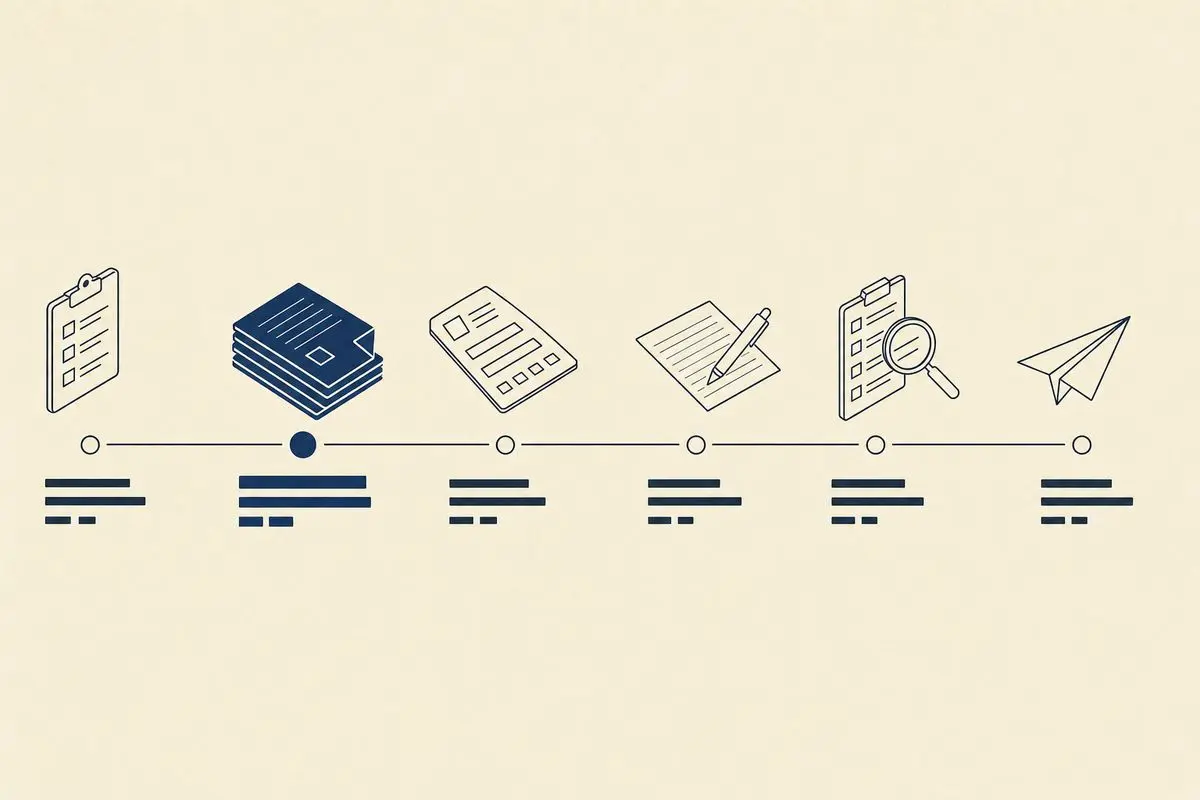
Most case prep is not lawyering. Open a typical economic-class PR file and walk it from intake to submission, and the categories that actually swallow the day come into focus: re-keying client information across surfaces, chasing and collating supporting documents, translating data between intake and IMM forms, sequencing the order of build, drafting submissions, internal review, and the act of submission itself. The judgment work — file theory, eligibility analysis, the choice of stream, the framing of an officer-facing letter — sits inside that stack. It is real, and it is the reason a client retained an RCIC. But by volume of minutes, it is the smallest category.
This is not a complaint about the profession. It is the structural shape of the work, and the gap between where practitioners think their hours go and where the hours actually go is the gap that compression strategies have to attack. If you believe most of your day is drafting, you will look for tools that make drafting faster. If you watch where the day actually disappears, you will look for tools that compress collation, translation, and sequencing — and you will find the recoverable hours sitting there, in the categories nobody talks about at conferences.
The six activity categories on a typical PR file
Decompose any economic-class file (Express Entry, PNP, AIP, federal skilled worker, CEC) and the same six categories appear in roughly the same order. The names vary by practice. The categories don't.
1. Intake and re-keying
The client supplies their data once — through an intake form, a phone call, a Google Doc, a paper questionnaire, sometimes through whatever surface they can find first. Then that data gets typed somewhere it is needed: into an internal CRM record, into a retainer agreement, into the body of an IMM 0008, into the IRCC online portal account, into the IMM 5669 background declaration, into the IMM 5406 family information form, sometimes again into a courier label, sometimes again into an invoice. Every re-keying is an opportunity for a number transposition or a date format error. The labour that re-keying represents is administrative, but the consequence of getting it wrong is substantive — IRPA misrepresentation regimes do not distinguish between an honest typo and a calculated lie, and a discrepancy across forms is exactly the kind of thing officers flag.
2. Document collation
Then there are the documents that are not data fields but artifacts: passports, transcripts, ECA reports, language test results, employment references, bank statements, marriage certificates, birth certificates, police certificates, photographs at the right dimensions in the right format. These come from the client across email, WhatsApp, encrypted portals, and occasionally physical mail. They arrive with the wrong file names, in the wrong formats, sometimes incomplete. Each one has to be received, opened, named according to the practice's internal scheme, filed in the right folder, checked for legibility, checked for expiry, checked for translation needs, and then queued for inclusion in the eventual submission package. None of this is lawyering. All of it is necessary.
3. Form translation
This is the category most invisible to outside observers. The client's life history sits in the intake — and now it has to be translated into the field grammar of the IMM forms. The address history block on IMM 5669 needs every address from age 18, with no gaps, in the IRCC date format, with the correct country codes. The personal history block needs every period of activity, with no gaps, with start and end dates that line up across forms. The travel history needs every entry and exit. Family information has its own field grammar, distinct from address history, distinct again from personal history. And every field on every form has to reconcile with every corresponding field on every other form, because IRCC's automated checks compare them.
This is the work that someone unfamiliar with the practice thinks is "filling in forms." It is not. It is data restructuring, performed under a constraint that the output be internally consistent across forms that were designed in different decades by different teams.

4. Sequence-checking
Files have an order. The retainer is signed before the file is opened. The intake is collected before the forms are drafted. The forms are drafted before the supporting documents are matched against them. The supporting documents are translated and notarized before the package is assembled. Some items have lifespan limits — police certificates, language tests, medicals — and have to be timed against the projected submission date. ECA reports have to be requested early. PNP nominations have their own clock. Provincial nominees who hit IRCC need an updated profile and a new round of documents. None of this requires legal judgment in the sense of A40 analysis or H&C narrative work. It requires the kind of judgment a project manager exercises: ordering tasks against deadlines, against expiry, against the availability of third parties.
5. Drafting
Now the lawyering. Submission letters that frame the file. Explanatory letters for awkward facts. LMIA narratives. H&C narratives. Reconsideration requests. Responses to procedural fairness letters. Schedule annexes. This is where craft sits. This is where two RCICs working the same file produce different outcomes. And this is the category that, for most practitioners, occupies a smaller share of the file than it deserves — because the previous four categories have eaten the morning before drafting begins.
6. Review and submission
Internal review (cross-form consistency, document completeness, accuracy against the intake). Client review (sign-offs, clarifications, corrections that ripple back through the forms). Final assembly. Upload to the IRCC online portal in the right order, in the right field, in the right format. Submission. Confirmation. File-close protocols. Trust accounting. Statement of services. Retention.
Where lawyering actually sits in this stack
If a senior RCIC reviews a file end-to-end and asks, honestly, which minutes were spent exercising the judgment a client retained them for, the answer is uncomfortable. It is the file-theory conversation at the start. It is the choice of program. It is the framing of the awkward fact in the cover letter. It is the strategic decision about whether to disclose the prior refusal, and how. It is the read on whether to argue genuineness or rely on weight of corroboration. It is the cover letter to a procedural fairness response, written carefully so that it is clear, complete, and fair to officer scrutiny. These are the moments that define competence and that justify the fee.
By minute count, they are a fraction of the file. The intake re-keying alone, across the surfaces named above, can match or exceed the total drafting time on a clean file. Collation of supporting documents, when the client is responsive, can match it. When the client is unresponsive — and clients often are, especially across time zones and language barriers — collation can dominate the file. None of this is news to practitioners who have tracked their own hours honestly. It is news to practitioners who have not.
Lawyering versus administrative: the split that actually matters
There is a useful split, and it is not "billable versus non-billable." Both categories are billable; both are properly captured in a fee agreement; both are part of competent representation. The split that matters is "compressible versus non-compressible." Lawyering is not compressible without loss. The cover-letter paragraph that frames a misrepresentation defence is not faster the second time you write it for a different client, because the facts are different, because the officer's likely concerns are different, because the right framing is different. You can build templates for the bones, but the meat is bespoke, and trying to compress it is how files lose their narrative coherence.
Administrative work is compressible. The client's date of birth does not change between intake and the IMM 0008. The address history that took an hour to coax out of the client does not need to be retyped into the personal history block — it needs to be re-shaped, which is something software can do. The supporting documents the client uploaded once do not need to be downloaded, renamed, and re-uploaded — they can be tagged once and surfaced wherever they belong. The order in which a file should be built is a known sequence — it can be templated.
The hours hidden in the four administrative categories are recoverable. The hours in lawyering are not — and should not be the target of compression at all.
Compression strategies, in order of yield
Templates that survive variation
The first compression layer is templates that are good enough to use without rewriting. Most RCICs already maintain templates — for cover letters, for intake forms, for retainers, for client communications. The question is whether the templates compress work or merely produce output. A retainer template that requires you to read every clause every time, because the practice has not standardized scope language, is producing output without compressing work. A retainer template that has stable scope language, varied only by named matter, file number, fee structure, and signature block, is compressing work.
The same is true for cover letters. A cover letter template that handles the routine seventy percent of a file — the parts that say where the client is, what they are applying for, what is enclosed, on what statutory basis — frees the practitioner to spend their drafting time on the bespoke thirty percent. A template that requires fresh drafting from scratch on every file does the opposite.
Autofill across IMM PDFs and the IRCC online portal
The technical compression with the highest practical yield, on a typical file, is autofill across the form layer. Once the client's data exists in a structured intake — date of birth, addresses with start and end dates, personal history with start and end dates, family members with relationships and dates of birth, identifiers, education entries, employment entries, travel entries — there is no operational reason it should be retyped into IMM 0008, IMM 5669, IMM 5406, IMM 5476, IMM 1294, the online portal account, or the supporting CIT 0002 if a citizenship file later opens for the same client. Each retype is a category-1 activity (re-keying) that compresses to zero with structured-data flow.
The constraint is that the autofill has to be accurate. A form-layer that fills wrong fields, transposes dates, or misformats a country code creates more work than it saves and introduces consistency risks across forms that officers will catch. Autofill that is reliable enough to skip the re-verification step is the compression. Autofill that requires the practitioner to re-verify every field is theatre.

Workflow templates that lock the sequence
Sequence-checking is compressible by templating not just the documents but the order. A workflow template for an Express Entry PR file is a checklist of every artifact required, in the order it should be requested, drafted, received, reviewed, and assembled, with the dependencies marked. The retainer is signed before the file opens. The ECA is requested in week one because it is on a third-party clock. The language test booking is confirmed in week one for the same reason. Police certificates are deferred until medicals are scheduled, because both have lifespan limits and have to align with the projected submission date.
A workflow template that encodes this sequence saves the practitioner from re-deriving it on every file. A practice that has thirty active files at once cannot afford to re-derive the order each morning. Encoding the sequence once, then instantiating it per file, compresses the project-management layer of category 4.
AI document review for the collation layer
Category 2 (collation) is harder to compress than category 3 (form translation), because it depends on the client. But the receiving end of collation is compressible. When a client uploads twenty documents over the course of a file, the practitioner has to verify legibility, expiry, completeness, format compliance, and sometimes content alignment with the intake. AI-assisted document review, used carefully, can flag the obvious issues — a passport image that is cut off, a translation that is missing the translator's affidavit, a bank statement that does not cover the required period — and surface them for human attention. The practitioner still owns the decision. The AI surfaces the candidates.
This is not a compression of judgment. It is a compression of triage. Triage is the activity that consumes the most attention in collation, because it is what determines whether the file is ready to assemble. Pushing the triage layer to a tool that is faster at first-pass scanning, while preserving practitioner authority over every confirmation, is the right shape of the compression.
The verification layer is non-negotiable
Every compression strategy above introduces a verification problem. If autofill writes data into IMM forms, the practitioner is responsible for the accuracy of those forms — the practitioner signs them, or the client does on the practitioner's advice, and IRCC holds someone accountable when the data is wrong. Section 91 IRPA does not absolve the authorized representative on the basis that a tool filled the field. CICC's Code of Professional Ethics does not create a software exception. The compression has to be paired with a verification layer, or it is malpractice waiting to happen.
The verification layer is simpler than it sounds, but it has to be designed in, not bolted on. Three habits cover most of it. First, structured-data review at the intake stage: confirm the canonical record (the intake's structured fields) is accurate before any autofill runs, because everything downstream depends on it being right. Second, cross-form consistency check before submission: read the IMM 5669 personal history against the IMM 0008 employment section against the IRCC portal entry, and confirm the dates align. Software can flag inconsistencies; the practitioner still has to decide they are real. Third, a final read of the assembled package by a second human if the practice supports it, or by the same practitioner with a 24-hour gap if it does not. Compression is what gives you the budget for that gap. Without compression, there is no time for the verification.
A practice that compresses without verifying is faster and worse. A practice that verifies without compressing runs out of hours. The combination is the goal — which is why the right framing is not "save time" but "redirect time," from the categories that drain it without producing legal value to the categories that protect the file.
What the redirected hours actually pay for
When the administrative categories compress, the hours do not vanish. They redirect. The first place they go, in a healthy practice, is back into category 5 — drafting. The cover letter that previously got fifteen minutes because the morning was eaten by re-keying now gets the hour it deserves. The procedural fairness response that previously got assembled in panic now gets a 24-hour drafting window with a sleep between drafts. The H&C narrative that decides the file gets the practitioner's full attention.
The second place they go is into category 6 — review. More files get a final read. More files get a second pair of eyes. Submission rates go up because the file is ready when the client is, not when the practitioner has finally cleared the collation backlog. Refusal rates go down because the cross-form consistency check has caught the typo before the officer does.
The third place they go is into the practice itself — into client relationships, into case-theory development, into CICC CPD obligations, into the kind of training that compounds across files. None of these are compressible. All of them benefit when the administrative categories stop dominating the day.
Pitfalls in the transition
Two failure modes recur when a practice tries to compress administrative work. The first is over-trust — the practitioner stops verifying because the tool is usually right. The first time it is wrong on a high-stakes form, the file is in trouble. The defence is to design the verification layer at the same time as the compression, not after. The second is under-investment — the practitioner adopts a tool, treats it as optional, and continues to re-key alongside it because the old habit is faster than learning the new one. The compression never lands, the time is not redirected, and the practice concludes that the tool did not work. The defence is to commit to the workflow change for a defined period (a quarter is usually enough) before assessing.
There is a third, quieter failure mode: the practitioner who confuses redirected time for free time. Compression that produces an hour back per file is not an hour of leisure. It is an hour to put back into the file, into the practice, or into the next client. A practice that treats redirected hours as slack quickly loses the discipline that produced the compression in the first place.
A note on what is not compressible
Three categories of work resist compression and probably should. Client trust development, on a substantive immigration matter, takes the time it takes. Substantive legal analysis on a hard file — A40 defence, H&C narrative, A41 inadmissibility argument, FC leave application work — is not faster the second time. CICC compliance obligations (file retention, trust accounting, conflicts checking) are not what slow a practice down; they are what makes a practice defensible. None of these belong on the compression list, and a practitioner who tries to put them there is making a different mistake than the one this post addresses.
The compression target is the four administrative categories. The protection target is everything else.
Closing
The reason most case-prep time is invisible to a practitioner is that the categories that consume it are individually small. Five minutes here, ten minutes there, a re-keyed address, a renamed PDF, a sequence cross-check. None of them feel large. Aggregated across thirty files in a quarter, they are the practice. The honest test is to track a single file end-to-end for a week — every minute, in named categories — and look at the result. Most RCICs who do this exercise are surprised by where the hours actually went, and the surprise is the start of the redirect.
VisaFlo is built to compress the four administrative categories on a Canadian immigration file: structured intake that flows into IMM PDFs and the IRCC online portal, document review that flags the issues a practitioner would catch on a first read, workflow templates that encode the right sequence per program, and a verification layer that keeps the practitioner in the decision seat. If you want to see the decomposition applied to your own file workflow, you can book a working demo and we'll walk through where your practice's administrative time is going and what's worth redirecting.