Five workflow changes that cut immigration case processing time by 40%. Based on real operational data from mid-size consultancies.

A 2024 survey by the Canadian Immigration Lawyers Association found that consultants spend an average of 38% of their billable time on administrative tasks that don't require legal expertise — document collection, data re-entry, status updates to anxious clients. That number has only climbed since then. With the 2026 regulatory landscape adding new layers of complexity — rising LMIA processing fees, expanded admissibility screening, and shifting PNP allocation caps — the administrative burden on immigration professionals has become genuinely unsustainable.
But here's what the data also shows: firms that restructure their workflows around five specific changes consistently cut their per-case processing time by 35–45%. Not through working faster. Through eliminating the friction that makes the work slow in the first place.

Why Visa Application Processing Takes So Long (It's Not What You Think)
Most consultants assume their bottleneck is volume. Too many cases, not enough hours. But when you actually map where time goes on a typical application, the picture looks different.
The Document Chase
The average work permit application requires between 12 and 25 supporting documents. These arrive via email, WhatsApp, WeChat, text message, physical mail, and occasionally fax — yes, still. A single missing document can stall a filing for days. Consultants report spending 45–90 minutes per case just locating, organizing, and confirming document completeness. Multiply that across 30 active cases and you've lost an entire work week every month to file management.
Manual Data Entry and Re-Entry
Client information gets typed into intake forms, then re-typed into government application forms, then re-typed again into internal tracking systems. Each transcription is a chance for error. Each error is a potential Procedural Fairness Letter (PFL) or outright refusal. IRCC data from late 2025 showed that 23% of returned applications contained data inconsistencies that originated from manual transcription — not from the applicant providing wrong information, but from the information being copied incorrectly between systems.
Deadline Juggling
Immigration deadlines don't exist in isolation. A biometrics appointment triggers a medical exam deadline. A Labour Market Impact Assessment (LMIA) expiry date constrains when the work permit must be filed. A change in processing times at a specific visa office shifts the entire timeline. Most consultants manage these cascading deadlines in spreadsheets or, worse, in their heads. The cognitive load is enormous, and missed deadlines carry consequences that range from costly refiling to permanent inadmissibility.
Client Communication Overhead
"What's the status of my application?" This single question, repeated across dozens of clients, consumes hours every week. It's not unreasonable for clients to ask — they're anxious, the stakes are high, and immigration timelines are opaque. But every email or phone call answering this question pulls a consultant out of substantive case work. One mid-size firm in Vancouver tracked their communication logs and found that status-check inquiries accounted for 6.5 hours of staff time per week. That's a full business day, every week, spent telling people "no update yet."
Regulatory Lookup and Compliance Verification
Immigration law doesn't stand still. In 2026 alone, practitioners have had to absorb the increased LMIA employer compliance fees and stricter Temporary Foreign Worker Program requirements, expanded admissibility and security screening timelines, and sudden PNP stream closures and Express Entry draw pauses announced with less than two weeks' notice. Staying current isn't optional — filing under outdated rules means refusals. But the time spent checking, double-checking, and cross-referencing current requirements adds up fast.
5 Workflow Changes That Cut Visa Application Processing Time
These aren't theoretical. They're drawn from operational data across firms that have implemented structured workflow changes and measured the results. None of them require hiring more staff. All of them require being willing to change how work gets done.
1. Centralized Document Intake Through a Client Portal
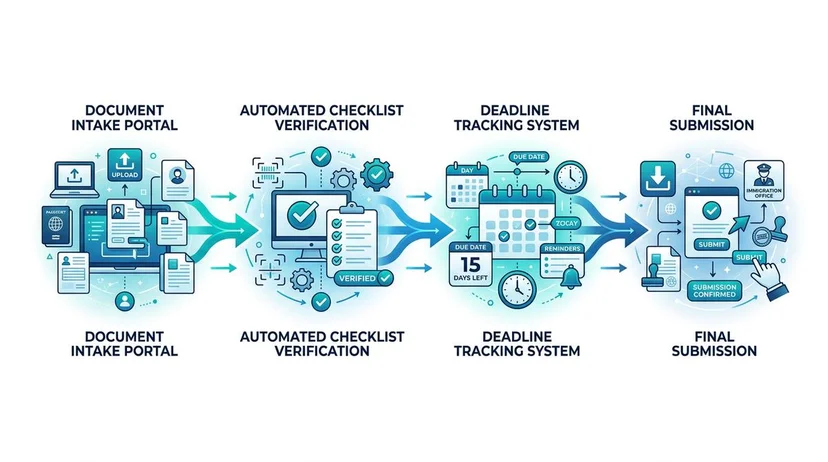
Stop accepting documents across five different channels. Give clients a single upload portal with clearly labeled slots for each required document. When a client uploads their passport scan, it goes directly into the right folder in the right case file. No downloading from email. No scrolling through chat histories. No "I sent that last week, let me resend."
The portal should validate file types and sizes on upload, flag incomplete submissions automatically, and send reminders for missing items without consultant intervention. This alone eliminates the single largest time sink in most practices.
Realistic time savings: 30–50 minutes per case on document collection and organization.
2. Template-Based Checklists by Visa Type
Every Express Entry profile requires the same core documents. Every LMIA has the same foundational steps. Every employer-specific work permit follows the same procedural sequence. Yet most consultants rebuild their task list from memory for each new case, or copy-paste from a previous case file and hope nothing was missed.
Pre-built, visa-type-specific checklists eliminate this. When you open a new PGWP case, every required document, every procedural step, every government form, and every internal review checkpoint should populate automatically. The checklist should reflect current requirements — updated when regulations change, not when someone remembers to update them.
This sounds simple. It is simple. It's also the change that practitioners most consistently say they wish they'd made sooner.
Realistic time savings: 15–25 minutes per case on setup and completeness verification.
3. Automated Deadline Cascading
When a biometrics appointment is scheduled for March 15, the system should automatically calculate that the medical exam must be completed by April 14, that the application must be submitted by May 30 based on current processing times, and that the client needs to be notified about passport validity requirements by March 1. Change one date, and every downstream deadline should recalculate.
This replaces the spreadsheet. It replaces the mental math. And critically, it replaces the panic when a consultant realizes at 4 PM on a Friday that a deadline they thought was next week is actually tomorrow, because a processing time change three weeks ago shifted everything forward and nobody updated the tracker.
Automated cascading doesn't just save time on deadline management itself. It eliminates the time spent fixing problems caused by missed deadlines — refiling fees, client management after a preventable delay, expedite requests that shouldn't have been necessary.
Realistic time savings: 20–30 minutes per case on deadline tracking and downstream error prevention.
4. Batch Processing for Similar Cases
If you have eight LMIA applications for the same employer, processing them individually means repeating the employer verification, company documentation review, and NOC code analysis eight times. Batch processing means doing it once and applying it across all eight cases, then handling only the applicant-specific variations individually.
This applies beyond employer-sponsored cases. Study permit applications for students at the same institution share common documentation. Family class sponsorship cases within the same household share address history, financial documentation, and relationship evidence frameworks. Identifying batchable case groups and processing shared elements together is a multiplier, not just an incremental gain.
The key is having a system that actually supports batch views and bulk actions. Trying to batch-process cases across disconnected file folders doesn't work — you need to see the cases side by side, apply shared data in one action, and track individual variations within the batch.
Realistic time savings: 25–40 minutes per case when batching is applicable (which, in most practices, covers 40–60% of caseload).
5. Real-Time Status Dashboards That Eliminate Status-Check Emails
Give clients a login. Let them see where their case stands. Show them what documents have been received, what's still needed, what stage the application is at, and what the next milestone is. Update it automatically as work progresses.
This is not about transparency for transparency's sake. It's about reclaiming hours. When a client can check their dashboard at 11 PM and see that their application moved to "Final Review" yesterday, they don't send the email at 8 AM asking for an update. When they can see that their police clearance certificate is the only outstanding document, they don't call to ask what's holding things up — they go get the certificate.
Firms that implement client-facing dashboards report a 60–75% reduction in inbound status-check communications within the first month. For a firm handling 50 active cases, that's roughly 4–5 hours per week returned to substantive work.
Realistic time savings: 10–15 minutes per case per week on client communication.
The Math: Where the 40% Reduction Actually Comes From
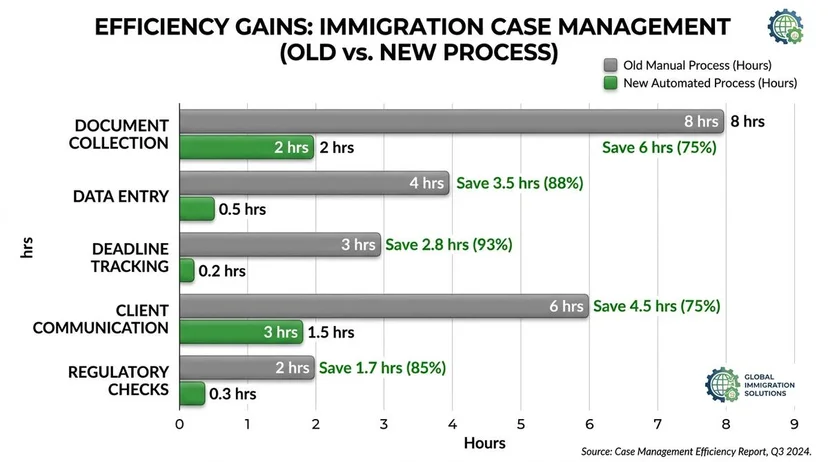
Let's ground this in numbers. Based on operational data from mid-size immigration consultancies (15–80 active cases at any time), here's what the typical per-case time allocation looks like before and after implementing these five changes:
- Document collection and organization: 75 minutes → 30 minutes (60% reduction)
- Case setup and checklist creation: 35 minutes → 12 minutes (66% reduction)
- Deadline management: 40 minutes → 15 minutes (63% reduction)
- Data entry and form population: 50 minutes → 30 minutes (40% reduction via auto-population from intake data)
- Client status communications: 30 minutes/week → 8 minutes/week (73% reduction)
- Regulatory verification: 25 minutes → 20 minutes (20% reduction — this still requires human judgment)
- Substantive legal analysis and case strategy: 90 minutes → 90 minutes (0% reduction — this is the work that actually requires your expertise)
Total per-case time before optimization: approximately 345 minutes (5.75 hours).
Total per-case time after optimization: approximately 205 minutes (3.4 hours).
That's a 40.6% reduction. And notice what didn't change: the time spent on actual legal analysis and case strategy. The 40% comes entirely from eliminating administrative friction. You're not cutting corners on quality. You're cutting the busywork that has nothing to do with quality.
For a consultant handling 25 cases per month, that translates to roughly 58 hours recovered. Fifty-eight hours that can go toward taking on more clients, doing deeper case analysis, or — and this matters — not working until 10 PM every Tuesday.
What to Look for in Immigration Case Management Software
Not every platform delivers these workflow changes equally. When evaluating software, focus on these criteria:
- Client-facing portal with guided document upload. Not just a file-sharing link. Clients should see exactly what's needed, upload to labeled slots, and receive automated reminders for missing items. The portal should work well on mobile — your clients are uploading passport photos from their phones, not sitting at desktops.
- Visa-type-specific templates that are actively maintained. Templates are only useful if they reflect current requirements. Ask the vendor how often templates are updated, and by whom. A template library that was last updated in 2024 is a liability in 2026.
- True deadline cascading, not just calendar reminders. There's a meaningful difference between "remind me about this date" and "automatically recalculate all downstream dates when this date changes." You need the latter.
- Batch processing capabilities. Can you view multiple cases side by side? Apply shared employer data across a group? Generate multiple forms from a single data set? If the system treats every case as an island, you lose the batch processing advantage entirely.
- Reporting and analytics. You can't improve what you can't measure. Look for platforms that track processing time by case type, identify bottlenecks in your workflow, and show you where your time actually goes versus where you think it goes.
- IRCC form compatibility. The software should populate government forms directly from case data. If you're still manually typing information from your case management system into PDF forms, you've replaced one data-entry problem with another.
- Security and compliance. Immigration files contain some of the most sensitive personal information that exists — passport numbers, financial records, medical history, family relationships. The platform must offer end-to-end encryption, role-based access controls, and compliance with Canadian privacy legislation (PIPEDA) and any applicable provincial requirements.
Stop Losing Hours to Problems That Have Been Solved
The immigration landscape in 2026 is harder than it's ever been. Rising LMIA fees and stricter employer compliance requirements have reshaped employer-sponsored immigration strategy. Expanded processing timelines mean cases sit in administrative review longer, which means more client anxiety, more status-check emails, more deadline recalculations. Sudden program closures and Express Entry draw pauses force last-minute pivots that cascade through your entire caseload.
You can't control any of that. What you can control is whether you're spending your time on work that requires your expertise, or on administrative tasks that a well-designed system handles better than any human can.
VisaFlo was built specifically for immigration consultants who are tired of duct-taping their workflows together with spreadsheets, email folders, and willpower. It includes every capability discussed in this article — client portal with guided uploads, visa-type checklists maintained by immigration professionals, automated deadline cascading, batch case processing, and real-time client dashboards — in a single platform designed around how immigration work actually gets done.
If you're spending more time chasing documents than analyzing cases, book a 15-minute demo and see what 58 hours a month of recovered time looks like in practice.